


SAKE blog


Published: 2025.12.19
Last modified: 2025.12.19
Can Sake be frozen? – What will happen when in a freezer

A simple but interesting question. Have you imagined the transformation of Sake when it is placed in a freezer? Does Sake freeze in the first place?
Freezing Sake can offer you a new insight of how to enjoy Sake. Let us explore the transformation of Sake being cooled down until it gets frozen.
Congeal points for alcoholic beverages

It is a universal truth that water turns into ice at the temperature of zero (0) degree Celsius. In other words, the congeal point for water is 0 degree Celsius. Can this be applied to alcoholic beverages, too? The answer is no. The congeal point for alcohol is lower than water and varies according to the degrees of alcohol the liquid contains. The congeal point of pure alcohol is -114.5 degrees Celsius, and the lower / softer the alcohol is, the higher the congeal point becomes. For your reference, the congeal point for the alcohol of 10 degrees is -4.6 degrees, while for 20 degrees of alcohol it is -11.2 degrees Celsius, and for 30 degrees of alcohol is -20.9 degrees Celsius, and for 40 degrees of alcohol is -30.7 degrees Celsius. Normal home-use frizers keep the inside at around -18 degrees Celsius. Therefore it is impossible to freeze Shochu, whiskey and other alcoholic beverages which are higher than 20 degrees by freezers at home.
Mizore Sake

Are you familiar with the word, Mizore Sake? Mizore Sake looks like sorbet. In this drink, Sake is partly frozen and the sorbet-like part bursts the aroma and flavours when placed in the mouth.
Mizore Sake looks just like normal Sake from its appearance. When being served into glasses, it surprisingly gains sorbet-like textures. The transformation is caused by a phenomenon called supercooling, and looks magical! Sake under supercooling condition are crystallized with slight shocks, which is why Sake instantly obtain sorbet-like textures when being poured into glasses.
Experiments show that Sake of 15 degrees alcohol becomes frozen at -7 to -10 degrees Celsius. However, by slowly and gently cooling down the drink, it can remain in the form of liquid until it reaches between -10 and -15 degrees Celsius. This is how Mizore Sake can be made using home-use fridges. Why don’t you give it a try to enjoy both the taste and its appearance.
Attention!

Do not freeze Sake in the glass bottles
When liquid turns into ice, its volume increases by 10%. Due to the expansion, the glass bottles can be damaged, in the worst case, broken. I recommend you use Sake vessel. Just in case, you should probably refrain from using your favourite vessel to this experiment as the weak vessels could have cracks from the volume increase.
Junmai Sake is preferable
Sake with brewer’s alcohol can change its taste through the freezing process. Some people say the drink gets bitter. Therefore, it is highly recommended to try freezing Junmai Sake, made purely from rice and water.
Handle with care to avoid giving even small shocks
Make sure you handle with care not to give any shocks. Even with a small bump against fridge doors etc., Sake starts to become sorbet. Of course, do not shake it to check whether is it properly processed. Gently and patiently pour the Sake to enjoy the best moment of sorbet Sake.
In brief, Mizore Sake, Sake sorbet can easily prepared using the features of supercooling. Looking at the transformation from liquid to sorbet can be entertaining, and it should definitely add a potential of Sake consumed being freezing cold. It will be a great company for a hot day. Enjoy home-made Mizore Sake next summer.

President & CEO, Kobayashi Junzo Shoten Co., Ltd.
Based in Osaka, I lead Kobayashi Junzo Shoten, a sake wholesaler founded in 1890. Through the cultural richness of Japanese sake, my mission is to connect people and bring smiles to dining tables around the world.
While technology continues to make the world feel smaller, the stories and traditions behind sake brewing can easily fade into the background. I see my role as a bridge—sharing the passion of brewers, opening doors for new audiences, and delivering sake in a way that feels more approachable and relatable.
I enjoy visiting sake breweries, learning about new rice varieties and brewing techniques, and spending time with toji (master brewers) and kurabito (brewery workers) to experience the spirit of sake-making firsthand. On this blog, I’ll share those encounters, my personal insights, and tips to help you enjoy sake even more.
Thank you for reading, and I look forward to connecting with you.
Latest Articles
One stop Quotation Inquiry System
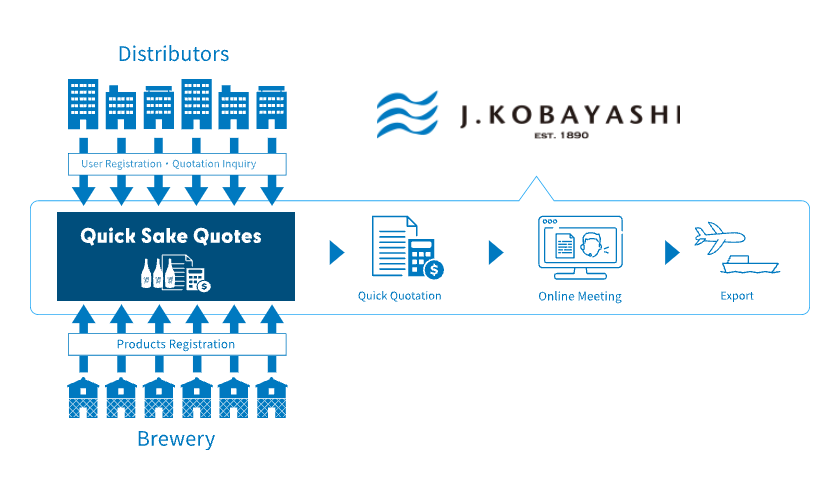
Quick SAKE Quote (QSQ) is a quotation inquiry system where you can receive quotations instantly. In most cases, it takes time to get a quotation for importing Sake, especially when dealing with several breweries. If you finally get an answer after a week or so, the response may be, “They already have a partner in your country,” and you have wasted your valuable time. Let's start your Sake import business efficiently with QSQ!
Read About QSQ
Contact Us
Quick SAKE Quote(QSQ hereafter) is a quotation inquiry system you can receive Quotation instantly.
Join our mailing list
Quick SAKE Quote(QSQ hereafter) is a quotation inquiry system you can receive Quotation instantly.
we will share content that:
Clear and explain the point without too much words.Contains at least one figure or clear example.Make you learn something new, or at least to remind you of it.